Thursday, May 20, 2010

Same shit, different accent.


I’m back from two weeks in Scotland and I’ve watched a good bit of British television waiting for the sun to set sometime after 11 PM so I could go to sleep. And that meant the chance to watch a lot of UK advertising.

I’m here to report that it’s fookin’ rubbish, as the Scots would say. Just as we Americans generally mistake an English accent for a sign of intelligence, we hear those same plummy tones in their spots and give terrible English advertising a free pass.

What’s remarkable is how the advertising in each category tends to suck more or less exactly as much as its counterpart in the States. Royal Bank of Scotland, which imploded more thoroughly than Citi or Wachovia and is now owned by the taxpayers, is running “real people” testimonials with the line “Here for you.” Sound familiar?

Jaguars and BMWs veer around hairpin turns in cool, desaturated, misty worlds devoid of oncoming vehicles to a trendy music track. Sound familiar?

An analgesic...can’t remember which one...was a cheesy problem/solution POS with a graphic demo showing the wonder ingredient rushing to “the site of the pain.”

Fairy Liquid (P&G’s UK version of Dawn) is doing a down-through-the-generations-mums-have-always-trusted-Fairy spot. Sepia to black and white to Kodachrome to today. Classic Procter twaddle.

Speaking of Procter & Gamble, they started this “If it works here, it’ll work there” business years ago. They even had a name for it: Search and Re-apply. Really. I know firsthand because I was always being asked to try the campaign that worked in Yemen or Uruguay or Chechnia back when I worked on P&G business.

And of course, depressingly, they were right, as they are about most things having to do with marketing. People are all the same. Blood pudding at breakfast instead of bacon doesn’t make for a different insight. It’s just a different part of the pig. The only reason for a global brand to do different advertising in each country is politics...keep the locals feeling empowered.

That’s why I want to laugh when I hear clients at focus groups in New Jersey (the world capital of focus groups) say that perhaps they should do more groups in Minneapolis or San Diego or wherever to get a more varied perspective.

Are you kidding? You can go to fookin’ Scotland an’ ye’ll hear the same bollocks, mate!

Monday, April 26, 2010

Look both ways before you name that thing.

So I was driving along this weekend listening to NPR and I heard the following:

"This program was made possible by Barnes & Noble, makers of the Nookie reader."

Christ, I thought, aren't there enough compendia of nookie in the world already?

Two minutes online set me straight: Nook® E-Reader.

A suggestion to anyone in the business of naming stuff, especially stuff whose modifier or descriptor ("E-reader") is not common parlance yet:

Put it in a sentence. Read it out loud. Sometimes the word right in front or right in back of your brand name can combine in unpleasant and unexpected ways.

Friday, April 09, 2010

What Nike and the Catholic Church have in common.

Well, for one thing they both exploit children.

For another, they are both so hermetically sealed off from the world of their constituents that it can lead them to say and do stupid and hateful things.

The Nike Tiger spot: mea culpa? Teachable moment? B-roll of a news item no longer news? Orville Deadenbacher II?

Who cares? It's the fact that Nike thought it was OK to leverage this miserable behavior in any way that's so galling.

You have to actually believe that preserving the millions of dollar of equity Nike built up through Tiger trumps simple human decency, in order to do an ad like this.

Sort of like you have to think the reputation of the organization is more important than the sufferings of individuals in order to compare criticism by its victims to anti-Semitism.

As the Semites would say, it's a shonda.

Monday, March 29, 2010

Footlong, I wish I knew how to quit you.

Three posts in a row about Subway advertising? That's the meme talking.

But obsession spun into revulsion yesterday. During one of the car/fast food/cellphone/car/fast food commercial breaks interrupted on occasion by the NCAA tournament, a new Subway spot appeared featuring two guys and footlong meatball subs.

Their shared passion for...meatballs and footlongs...sends them off into a homoerotic reverie. When they snap back to the here and now, awkwardness and overcompensating bro-ness ensues.

Ugh. Didn't Snickers try this bullshit on the Super Bowl last year, playing homophobia for cheap laughs with the frat boy set? Just because Subway is (quite rightly) perceived as skewing towards women with their emphasis on healthy eating and weight loss doesn't justify this stupidity.


"I think I'll just stick with the turkey wrap."

Tuesday, March 23, 2010

$5 foot longs are f---ing fabulous!


Vice President Biden caught on mic; calls health care bill a 'big f---ing deal'

How long before the F-bomb is dropped into advertising? It's going to be in my lifetime, I'm pretty sure of that. And maybe even while I'm still sentient.

Why am I so sure? Because I hear it every night on teevee, and every day seeping through someone's ear buds on the subway or the elevator. Advertising lags popular culture and mores, but only by about 5 years. By the time the generation of marketers raised on Jay-Z and The Sopranos makes it to the C-suite, you're gonna hear advertising that sounds just like open-mike night at the White House.

By the way, not to carp or anything, but "big f---ing deal" usually means it's not a big f---ing deal at all. What the Vice President meant to say was "...f---ing big deal" as in "That $5 foot long is f---ing fabulous!"

Friday, March 19, 2010

They're ambulance-chasing scum, but they can write a mean headline.

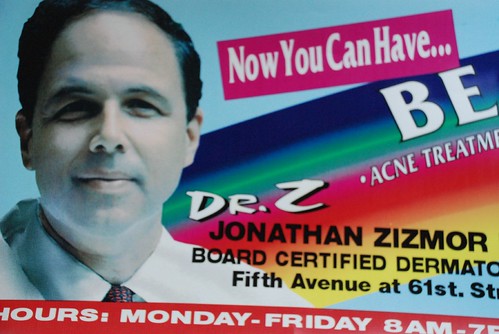
Law firms are right up there with dermatologists and local real estate agents for horrendous ads. They all seem to think that a wildly grinning shot of the boss, combined with Microsoft Word clip art and garish typography, are the ticket. For New York subway riders, Dr. Zizmor's oeuvre is the apotheosis of the genre.

But a few days ago, on the back of a city bus, I saw a simply art-directed ad for a slip-and-fall law firm (whose name I forget, unfortunately) with a picture of a hand gripping a cane and this headline:

We've never seen a cane strong enough to support a whole family.

Whoever wrote that, if handing out business cards in the ER doesn't work out for you, give me a call.

Friday, March 12, 2010

And the winner for Next Bit of Hip Jargon Destined to Wind Up in an Ad for a Tired,Dated Brand is...

..."I'd hit that."

The critical moment may have been when Gabourey Sidibe said it about Gerald Butler on the Oscar red carpet show.

You watch. "I'd hit that" will wind up being the new theme for Pepsi or Bud Light or KFC in, oh, 12-18 months. That's the usual time lag.

The ur-moment for this type of thing was when Buick--Buick!--appropriated "It's all good" for a while in the early 2000s. Although I guess car companies would shy away from this one. "I'd hit that" and unintended acceleration problems don't mix, even in adland.

Wednesday, March 10, 2010

The perfect killer meme.


Admit it. "Five Dollar foot long" is the last thing you hear in your head before you go to sleep and the first thing you think when you wake up.

It's OK. You've been attacked and overwhelmed by a perfect storm of a meme, as has everyone else. We're just mindless bots in Subway's world, and if you don't believe it, check the numbers. $3.8 billion in footlongs is a frikkin' pandemic of footlong consumption.

Who came up with this killer mental tapeworm? Hint: not corporate, not the ad agency and it wasn't heard first in a focus group room. A franchisee in Miami did it because he likes round numbers and it's easier giving change on a $5 item than it is on a $10.

So much for the consumer engagement strategy.

So why, why, is "$5 foot long" so mercilessly effective? Let's break it down.

First, it's a jingle. The biggest dirty secret of advertising is that jingles work. No creative under the age of 60 wants to do them, the great jingle houses are all gone, but jingles are what everyone remembers.

Second, "Five dollar foot long" is an incredibly felicitous combination of sounds. It rolls off the tongue like it was coated with mayo, and the alliterative repetition of F sounds gives it that final touch.

Third, it's amazingly and incontestably dirty, yet manages not to offend those whose minds don't go that way...whoever they are. I mean, it's a full 12 inches long! And only $5! That's a lot of...value.

As Jessica Simpson said, in reference to full 1080p HD television, "I don't know what it is, but I want it."

Wednesday, March 03, 2010

Taking down the wall.


Now roll them cases out and lift them amps
Haul them trusses down and get'em up them ramps...

But when that last guitar's been packed away
You know that I still want to play
So just make sure you got it all set to go
Before you come for my piano


I haven't posted for 2 weeks because I haven't done anything for 2 weeks except wrangle a huge, complicated new-business pitch into shape. The presentation was yesterday, it was kick-ass and now we wait.

And now I take down the wall.

The wall is covered in cork tile, and I've had one everywhere I've worked since I became responsible for other people's work.

The wall is the only way I know where I am on a project. It starts with a brief, pinned up on the extreme upper left, and then blankness. Slowly, thoughts, questions, to-dos, swipe, scrawled end-lines fill the wall. These, in turn, are replaced by layouts, scripts and key frames, and then comps, storyboards and ominous patches of bare brown cork representing stuff that still needs doing.

Eventually the wall gets filled, and its next role comes into play. The pieces get rearranged, clumped into buckets, put into order...and some get tossed. At this point, the wall is not a chalkboard, it's a scoreboard. And since my office door is open 99% of the time, everyone comes by to check the score.

It's all very low-tech and also, especially at the end, very 30,000 feet, which makes it easy to forget how every piece of paper that went up on that wall was turned into something actual and beautiful by incredibly dedicated, hardworking people working crazy stupid hours.

From the elegant "place mats" that greeted clients as they took their seats to the rocking goodie-bags they got on the way out; from the perfectly edited video clips to the carefully recreated retail shelf environment they assembled in the presentation room; from the hours of taping and transcribing interviews to the wee hours of proofreading and revising, here's to Meredith, Matt D, Kim M, Jess, Anthony, Katie and Liz.

And now the wall comes down...easy as pulling out a tack. Five minutes, and the wall is bare again. This afternoon, the first casting selects from an upcoming shoot go up.

But the band's on the bus
And they're waiting to go
We've got to drive all night and do a show in Chicago
or Detroit, I don't know
We do so many shows in a row
And these towns all look the same
We just pass the time in our hotel rooms
And wander 'round backstage
Till those lights come up and we hear that crowd
And we remember why we came


--Jackson Browne, from "The Load-out"

Friday, February 19, 2010

Here's your hoop. Now jump.

I'm in the middle of a big (for us) new-business pitch, and I'm also just wrapping up reading Game Change by Mark Helperin and John Heileman, an unbelievably fascinating inside look at the 2008 Presidential race.

A pitch, in theory at list, allows a prospective buyer (the client) to sample the actual wares of different sellers (i.e., agencies) under controlled circumstances. You can't just stand up and yammer for 2 hours and win a pitch. You have to analyze a problem, figure out a strategy, come up with novel ideas about how to execute, and throw in a few tiebreakers...a research video, a store mockup, or some other kind of meeting theater.

Maybe we should consider doing something like that for major political contests. Instead of watching candidates debate, posture, speechify and trash one another and then have to commit to one of them for at least 4 years, maybe we give them all the same brief and tell them to come back in 6 weeks with a presentation.

I'd rather watch a mood ripomatic than a political attack ad any day, and watching vendors jump through hoops is much more fun than listening to them bullshit.

Just leave the search consultants out of it.

Monday, February 08, 2010

Football, life and everything else.

My PC friends aren’t going to like this, but I saw nothing wrong with the Tim Tebow commercial. I vehemently disagree with the anti-abortion position it espouses, but this spot made its point simply, inoffensively, and pretty effectively.

In fact, the strongest emotion it evoked in me was frustration. Frustration with Planned Parenthood, NOW and other pro-choice groups who have let themselves and their cause get outmaneuvered and out-communicated. “Pro-choice” would describe 90% of Hollywood and Madison Avenue, but none of the talent there is being utilized.

I have this nagging feeling that pro-choice groups feel they are morally above something as unseemly as communication strategy or advertising...that these are activities only the Dark Side indulges in. Part of that whole “I’d rather be pure and lose than compromised and win” mind-set that cripples the Left.

I say: Shut the F up and go out and find your own upstanding mother and children. Film her talking about how she made an incredibly difficult and painful decision years earlier, when her circumstances would have condemned a child to abandonment or worse. Let her show her love and pride in her children. Put it on the Super Bowl and pass the nachos.

You’ll have something to cheer for and you’ll be doing your own daughters a big favor.

Wednesday, January 27, 2010

What's become of the baby?

Why is there a new baby on E-Trade commercials? Why does he have a new voice? Why is he less funny?

Don’t ask E-Trade. They’re pretending it’s the same kid, with the headline on their landing page announcing “The E-Trade Baby is back!”

Here are some possible explanations:

1) They didn’t shoot enough footage of the original baby before he turned big and uncute.

2) E-Trade got a new CMO who wanted a baby who was “on his team.”

3) The original copywriter left Grey and is now an ECD somewhere.

4) The original copywriter was also the original baby voice.

5) Somebody thought it would be a good idea to “optimize” the campaign as it headed into its second year.

My guess is the answer is some mix of all of the above. Really wonderful ad campaigns truly are lightning in a bottle, much more so than anyone associated with them would ever admit. Change even one element of the mix, and the spark is gone.

Sunday, January 24, 2010

The speech is free. The media buy's gonna cost you.


I get paid to turn the business priorities of large companies into messages that influence how people think.

It puts bread on the table, children through college, and the occasional smile on my face.

So you’d think, when the Supreme Court ruled 5-4 this week that corporations were entitled to the same First Amendment rights as individual citizens, that I’d be as happy as Newt Gingrich.

I’m not.

For Justices Kennedy, Alito, Roberts, Scalia and Thomas, let me point out some differences between people and corporations.

People have feelings, beliefs, hopes and fears. Corporations do not.

People have families. Corporations do not.

People have morals. Corporations do not.

People are mortal. Corporations, properly managed, can live forever.

People speak their minds in barber shop or blogs. Corporations buy TV commercials.

Do you really want to give an entity that has no obligation to do anything in this world except make money the right of free speech?

When I write an ad, I can’t lie. I can’t say using the competitor’s calling plan leads to genital herpes. Why? Not because it’s not true. Not because my client company doesn’t like telling fibs. The reason I can’t make stuff up is because my client can get sued and lose a boatload of money. Corporations don’t like getting sued.

But now any company or trade group with the money can pour millions of dollars into baseless lies about “issues” and candidates with no fear of legal or financial exposure.
Nice job, Supremes. Nice job.

Wednesday, December 30, 2009

Is that a Na'vi in your Happy Meal?

A few days ago I saw "Avatar", which is the best argument in recent years for the continued existence of movie theaters. The visual experience is overwhelming, and the old-fashioned good-triumphs-over-evil storyline prompts communal feelings of joy and triumph.

The very next day I saw a McDonalds promotional spot that, in the way these spots do, mashed together bite-and-smile shots with clips from "Avatar". I don't blame McDonalds for jumping on the "Avatar" bus, and I certainly don't fault James Cameron and his bankers for laying off a chunk of their $350 million bet. The co-promotion itself is pretty ambitious, with scannable code on McDonalds packaging that you show to your computer's webcam to unlock proprietary "Avatar" content online.

But the :30 spot is a horror. I've worked on fast food, so I know the promo spots go to the B-team. It just kills me to see images from this beautiful movie flattened, shrunk and dunked in ketchup. How much better it would have been to have 2 dudes shoving fries in their face talking about the movie:

"Didja see Avatar yet?"
"No--how was it?"
"Awesome."
"Really? Like...how?"
"Can't really describe it, man. You gotta see it. Don't eat that last fry."
"Just tell me about that blue chick."
"You gotta see it. Talking about it just ruins it."


etc etc

Sampling laundry detergent or cookies works. Sampling art: not so much. Here it would have been better to suggest, conceal and tease.

Monday, December 21, 2009

How to sell buying less.


One of the nicest sentiments I’ve seen expressed in any, er, branded content this holiday season isn’t even a holiday ad.

It’s eBay’s new campaign, an example of which you see above. If you can't read the headline, it says "Last year's music player at half price still plays this year's music at full volume."

The urge to get and have will always be with us, but eBay’s message that gently used things can still have meaning and value is a good one, and in sync with the 2009 zeitgeist without being manipulative.

Spending $150 for last year’s model instead of $300 for this year’s doesn’t automatically mean $150 left over for charitable giving. Or debt reduction. Or savings for college. But it at least opens the door of possibility, and gets you thinking.

Not to mention, it’s a very smart, insightful way to get people to think differently about eBay, and it isn’t even the first. Goodby’s “People are good” campaign of a few years back, when people still feared internet commerce with strangers, was crazy good too.

The only off-note is the stupid endline “Come to think of it”, which has been used on everything from cigarettes to cars to food—usually by brands that are on the brink of extinction because no on thinks about them anymore.

The best endline would have been no endline. But that doesn’t take away from a singular achievement: a campaign that sells its product hard at the same time it encourages you to be a better person.

Thursday, December 10, 2009

It took a lying evil behemoth to get me to blog again.

It’s no blinding insight that advertising often resorts to, ahem, a selective presentation of facts to make its case. So do we all, every day, in our dealings with others. Freshly blown-out hair and artful make-up are a selective presentation of the facts. Your resume is a selective presentation of the facts. That guy’s picture on match.com is a selective presentation of the facts.

We live in a world of truthiness. We know our mileage may vary. We know prescription drugs have all sorts of side-effects. We get it. But there are instances in advertising, as in life, where the presentation is so utterly, fantastically deceitful, so at odds with “the facts on the ground” as the generals say, that even a lard-ass, narcoleptic failed blogger is roused to protest.

Seen this ad?


You can’t have missed it. AT&T, which was seeing big share gains against Verizon Wireless purely because of its exclusive iPhone offering, was knocked on its ass when Verizon Wireless started its “We have a map for that” counter-terrorism surge. “We have a map” isn’t going to win anything at Cannes this year, but it’s tearing a new one for AT&T by reminding everyone of a simple truth: AT&T’s coverage sucks. That they appropriate and pervert Apple’s “We have an app for that” to deliver the message just makes it nastier and more memorable. And the visual comparison of Verizon’s coverage, blotting out the entire map of the United States except that place in Idaho where the Unabomber lived, to the hollowed-out emptiness that is AT&T’s coverage, is incredibly powerful.

So how did that anemic coverage schematic grow into the vast orange, sea-to-shining-sea coverage map in AT&T’s ad?

They lied. Not in the “We can grow your penis overnight” way of low-life, unregulated advertisers. Because AT&T isn’t a corner hustler. It’s a big company, with a big legal department. So they did it the old-fashioned way: in the fine print.

As a service to readers in their baby-boom years, and to young ‘uns who read digital newspapers, let me bump it up a few point sizes, make it nice and big so you can read it:

“Map depicts an approximation of outdoor coverage. Map may include areas served by unaffiliated carriers, and may depict their licensed area rather than an approximation of their coverage. Actual coverage area may differ substantially from map graphics.”

“Actual coverage may differ substantially from map graphics.” This is not “Your mileage may vary,” brothers and sisters. This isn’t even Glen Beck on a bad day. This is lying, corporate style. For shame.

Wednesday, October 28, 2009

Getting 'Faced.


After disdaining Facebook from afar ever since my daughters starting obsessing over it 4 years ago, I joined up 3 weeks ago so I could disdain it up close.

I was not disappointed.

After I completed the signup process, the first person suggested to me as a Friend (as opposed to a l/c friend, who is someone you actually know and like and see from time to time) was my 75-year old former boss from the ‘80s, now living la vida loca in Boca. Facebook had clearly jumped the shark long before my sad 57-year old self signed up.

I went to my Homepage?/Room?/Place?/Wall? and gazed in wonderment at the spectacle unfolding before my eyes. I felt guilty and ashamed—but not enough to keep me from scrolling, mesmerized, through the idle thoughts of current employees, bikini photos of ex-employees and the minute-by-minute documentation of all these people’s lives.

It would be easy to think, Jesus, who cares? Except that each dispatch—“Just got back from the dentist.” “Psyched for the weekend!!!” “Having ramen for dinner.”—is greeted with a chorus of thumbs-up validating comments.

I felt like Shelly Duvall's character in The Shining when she discovers the bat-shit crazy stuff Jack Nicholson's been writing all this time. The horror!


Three weeks rummaging through this dumpster of compromising pictures, coma-inducing reportage and rampant narcissism lead me to these conclusions:

1. People have way too much time on their hands.

2. Facebook is an irony-free zone. It may be a relatively new medium, but it’s about as edgy and cynical as Lutheran Bible camp.

3. Using a Facebook Wall to talk to someone is like using a Predator Drone to conduct diplomacy.

4. When your client, regardless of category or target demographic, asks you whether they should have a Faebook “presence” (the word itself is a dead giveaway), say No.

Regarding the latter, I used to say No without having ever been on Facebook myself. Now I can say No with much greater confidence. And, because I’d never ask a client to do something I wouldn’t do myself, I’m de-Friending?Listing?Booking? myself today.

Thursday, October 15, 2009

A challenging day.


Humankind cannot bear too much reality."
--T.S. Eliot, "Burnt Norton"


It's been a challenging day.

The weather has been challenging, the fraudulent use of my credit card in Madrid is a challenge, and my painting contractor's sudden, unexplained disappearance will certainly pose a challenge going forward.

My 3rd quarter mutual fund letters to shareholders make abundant use of the word "challenging," as do CEOs reporting missed targets on analyst calls. Having all their franchise players injured was certainly a challenge for the Mets.

The beauty of "challenging", as opposed to, say, "totally and completely fucked," is that challenge is noble and invites rising, whereas total and complete fucked-upness is depressing and invites sitting down or--even better--going to sleep.

Euphemisms have their place in civilized life. They grace the skids for little white lies meant as a kindness, and they minimize the gross factor in discussions about bodily functions. But I've never understood euphemisms that mask truths, fool no one, and leave neither speaker or listener feeling better.

Friday, October 09, 2009

Make yourself scarce.


Seeing these new Starbucks ads everywhere confirmed my feeling that whatever elan this brand once had, it has lost. In fact, the sheer ubiquity of the campaign added to the problem. I mean, here’s an ad that basically sells scarcity—we use only 3% of the world’s beans—and then they plaster the message everywhere!

Part of what used to make Starbucks cool was that they didn’t advertise. Yes, they did the occasional (and sweet) holiday effort, but they didn’t spend a lot, the ads didn’t sell very hard, and it all felt artisanal and small-bore...exactly what you want from makers of $3.00 cups of coffee. Dropping $100 million on an ad campaign says “We’re the Micky D of coffee” no matter what the headline is.

In a spectacularly misguided effort at social-network relevancy, Starbucks CEO Howard Shutlz laid out his thinking for the company’s “partners” (read: hourly employees) in this YouTube video:


If you’ve built your brand through advertising (as, for instance, Folgers did in coffee), then there are good reasons to keep advertising. If you built your brand as “the third place”—essentially, an experience rather than a bunch of product claims—then advertising ought to be a waste of money at best.

Tuesday, October 06, 2009

Bring back the dead guy in the fedora.


Let's say you were Lexus and you were introducing a vehicle in a new segment, somewhere between the ES and GS. Wouldn't this be an appropriate headline? Builds on their endline of the last 20 years or so, highlights a new entry, has the self-confidence bordering on swagger that Lexus has earned.

Too bad it's an ad for...Buick. What? You didn't notice that?