Marketers Struggle to Get Folks to Stay Put for the Commercials - New York Times
"The whole goal here is to blur the line between content and advertising message,” said Hank Close, president for ad sales at MTV Networks."
Listening to a media-sales executive exult that his network’s goal is to completely blur the distinction between content and advertising is like listening to a tobacco-industry executive talking about how cigarettes are nothing more than an optimized nicotine-delivery system.
The difference is, the tobacco guys were talking behind closed doors. This guy’s Tourette’s-like outburst was freely directed at the press.
Every time the firewall between advertising and content is torn down, it ends in tears.
The GEICO cavemen kicked ass in commercials. Advance sneak peaks at the TV series suggest it won’t last 2 weeks. Ham-fisted product placement eventually made series like “The Apprentice” and “Queer Eye” unwatchable. Ad guy Brian Tierney’s takeover of the Philadelphia Enquirer is headed down the same dead-end street.
The same technology that empowers viewers to fastforward past crap commercials also lets them post the good ones on YouTube and leverage the client's media buy by orders of magnitude. The challenge, Mr. Close, is not to pollute content with badly disguised ad messaging, but to make ads that merit watching.
Wednesday, May 23, 2007


Friday, May 11, 2007
Citi: not so pretty.

Well, it had to happen I guess, but seeing the awful reality of it is almost too much to take. Citibank or Citicorp or Citi or whatever it is has junked its “Live Richly” campaign in favor of ….of….
“Let’s get it done.”
The red arch logo has been wrenched from its context as an umbrella (necessary with the divestiture of Travellers is my guess) and turned into a bridge. Because Citi is your bridge from dream to reality. From a sketch on a napkin to an IPO. From, let's see...from Dick Cheney on a carrier deck to Dick Cheney in a perp walk.
The inevitable anthem intro commercial rounds up all the usual suspects: the simple, repetitive Phillip Glass-like score; the hopeful children; the intense entrepreneurs; the retired couple on the dock; the proud college graduate. Citi’s dead-man-walking CEO Charlie Prince wanted to put his own stamp on the company’s image. In this derivative, clueless effort, he has succeeded wildly.

“Live Richly” had its detractors, and for sure a bank talking about money not being everything in life is an easy targets for cynics, but jeez, at least they took a shot. It avoided most financial-advertising clichés, it appealed to people’s better nature, and it set them apart. In a category where 90% of what you can say is regulated by statute, that’s pretty good. When Sandy Weill comes back to rescue Citi from his own anointed successor, I’ll bet anything that “Let’s get it done” will be done as well.
Wednesday, May 02, 2007
Period abuse.
Forgot to mention in my last post that this new Travelers campaign ends with this somewhat opaque slogan:

Not sure what it means, but I'll let it go. It's planner BS they had to paste onto the work to put it "on brief". No, the thing I want to focus on is the period abuse. The. Way. An extra period. Is inserted. To make the line. Punchier.
Copywriters do this all the time. I know I have (Weight Watchers. Real food. Real life. Real results.). And there is a hilarious passage in Matthew Beaumont's book E in which the agency's hack Creative Director is ID'd by a former art director partner by the period abuse in his emails.
And no wonder. Maybe as a reaction to chronic period abuse by their writers, most art directors hate putting one period, let alone 2 or 3, in headlines or tag lines. Why mess up nicely kerned type with some random...dots?

Not sure what it means, but I'll let it go. It's planner BS they had to paste onto the work to put it "on brief". No, the thing I want to focus on is the period abuse. The. Way. An extra period. Is inserted. To make the line. Punchier.
Copywriters do this all the time. I know I have (Weight Watchers. Real food. Real life. Real results.). And there is a hilarious passage in Matthew Beaumont's book E in which the agency's hack Creative Director is ID'd by a former art director partner by the period abuse in his emails.
And no wonder. Maybe as a reaction to chronic period abuse by their writers, most art directors hate putting one period, let alone 2 or 3, in headlines or tag lines. Why mess up nicely kerned type with some random...dots?
Tuesday, May 01, 2007
Risky business.
I made my own advertising mash-up last night. In my head. No editing software necessary.
I was watching Heroes (itself a pretty good mash-up of comix, sci-fi and nerdy soap opera) and a spot came on with this sleazy character named Risk. Risk wears a cream-colored zoot suit and throws banana peels out there for you to slip on.
I think this spot was a :60. It was lonnnnnng. And, as is the fashion, it saved mention of the advertiser to the very end. Which gave my overly active imagination plenty of time to fill in the blanks. I’d been seeing a ton of new print ads from Marsh (aka Marsh & McClennan before the scandal) that looked like this:

So, naturally, I thought this new spot was the TV translation. Here he is--the Upside of Risk we've been looking for! Except what could be the Upside of a meddling douchebag who looked like Snidely Whiplash? Wow, I thought to myself, where was Marsh going with this?
And then a telltale red umbrella appeared, and the Travelers Insurance logo. And some drivel about how Risk never sleeps so your unsurance needs to keep up, which I assume means minimizing the downside and not finding the up. And, suddenly, my mash-up movie was over. But for 55 seconds, the commercial playing in my head was not the one on the TV.
I was watching Heroes (itself a pretty good mash-up of comix, sci-fi and nerdy soap opera) and a spot came on with this sleazy character named Risk. Risk wears a cream-colored zoot suit and throws banana peels out there for you to slip on.
I think this spot was a :60. It was lonnnnnng. And, as is the fashion, it saved mention of the advertiser to the very end. Which gave my overly active imagination plenty of time to fill in the blanks. I’d been seeing a ton of new print ads from Marsh (aka Marsh & McClennan before the scandal) that looked like this:

So, naturally, I thought this new spot was the TV translation. Here he is--the Upside of Risk we've been looking for! Except what could be the Upside of a meddling douchebag who looked like Snidely Whiplash? Wow, I thought to myself, where was Marsh going with this?
And then a telltale red umbrella appeared, and the Travelers Insurance logo. And some drivel about how Risk never sleeps so your unsurance needs to keep up, which I assume means minimizing the downside and not finding the up. And, suddenly, my mash-up movie was over. But for 55 seconds, the commercial playing in my head was not the one on the TV.
Monday, April 23, 2007
Oh, the humanity!
 I consume a lot of business media, so I’m seeing a lot of human-ness lately.
Cisco is running a campaign about something called “The Human Network” which must be what I’m on right now because my wireless connection speed is dial-up slow.
And a few pages later, Dow (aka Dow Chemical) brings us “The Human Element,” which I guess is...them?
These two outfits must have gone to the same focus group, in which they found out that people think big business is cold, impersonal and amoral. Hence the need to “humanize” their respective brands.
“Human” is one of those words that, when you see it in the context of advertising, is best understood by putting the word “not” in front of it. So, for example, when Dow says it’s all about “The Human Element”, what they mean is “The not-Human Element.” It’s Dow Chemical, for Chrissakes. Better living through chemistry!
Here’s some other terms that, like “human,” pretty reliably mean their exact opposite when used in advertising:
Personal
State of the art
Smart
Caring
Green
Unique
Feel free to add your own to the list.
Thursday, April 19, 2007
One stand-up guy.
I’ve always admired Mike Hughes of The Martin Agency, and a recent conversation with him in Creativity (or as they typographically refer to themselves, Creat Ivity), only reconfirms my respect.
Hughes freely admits that he didn’t like the gecko concept when it was first presented, and only relented after repeated pitches by his team—and only because he believed it was just a one-shot.
How many creative directors do you know who will cop to something like that? A lot of history has been rewritten by CDs who claim early support—or, worse, authorship—of ideas that they originally cra pped on.
Hughes also volunteered that while he was not initially keen on the gecko he had a lot of heart for an idea revolving around flying monkeys, which was pulled after only a few days on air. Not surprisingly, no one else is trying to horn in on the credits for that one.
Hughes freely admits that he didn’t like the gecko concept when it was first presented, and only relented after repeated pitches by his team—and only because he believed it was just a one-shot.
How many creative directors do you know who will cop to something like that? A lot of history has been rewritten by CDs who claim early support—or, worse, authorship—of ideas that they originally cra
 pped on.
Hughes also volunteered that while he was not initially keen on the gecko he had a lot of heart for an idea revolving around flying monkeys, which was pulled after only a few days on air. Not surprisingly, no one else is trying to horn in on the credits for that one.
Wednesday, April 18, 2007
Sloppy seconds

Advertising Age - Kmart Hands DraftFCB $200 Million Creative Account
To quote my daughters: Ewwww.
Weren’t DraftFCB’s presentation boards for Kmart still damp from Julie’s embrace?
I’ll leave the Julie-bashing to others. But K-Mart! Have some self-respect. Do you really have such WalMart envy? They’re falling over themselves trying to be Target. And didn’t you see Howard’s video address to his troops? He’s Sammy Glick and Ursula the Sea Witch’s love child!
Tuesday, April 17, 2007
These are the End Times.
Nike is falling out of love with W&K.
Altoids dumped Leo Burnett.
Dead people come back to life and talk about popcorn.
What other signs do we need? Lee Clow’s head turning 360% around on his neck?
It’s time to get right with whoever your deity is.
Google, AKQA, R/Greenberg and a few other lucky souls are locked and loaded for The Rapture.

The rest of us will be left here to contend with The Beast, forced to prove ROI endlessly, speaking corporate babble we don’t even understand, locked in a focus-group facility for an eternity while harpies shriek and tear at our work.
In the meantime, we just got a nice new piece of business . Things are looking up!
Altoids dumped Leo Burnett.
Dead people come back to life and talk about popcorn.
What other signs do we need? Lee Clow’s head turning 360% around on his neck?
It’s time to get right with whoever your deity is.
Google, AKQA, R/Greenberg and a few other lucky souls are locked and loaded for The Rapture.

The rest of us will be left here to contend with The Beast, forced to prove ROI endlessly, speaking corporate babble we don’t even understand, locked in a focus-group facility for an eternity while harpies shriek and tear at our work.
In the meantime, we just got a nice new piece of business . Things are looking up!
Monday, April 16, 2007
It's about the work...pause Not!
It’s enough to cause terminal cognitive dissonance.
On one hand you’ve got sad but familiar stories like VW getting pulled from Arnold, or Altoids from Burnett, when newly-installed clients bring in old agency buddies. Relationship trumps the work.
On the other hand, you’ve got Bob Barrie and Stuart D' Rozario taking the entire honking United business with them from long-time agency Fallon, where they created their beautiful campaign. Work trumps relationship.
Or…not? What it’s hard for outside observers to ever know is: did the decision makers at United keep the business with its creators because, bottom-line, it’s about the work? Or were Barrie and D'Rozario, and not anyone in management, the key relationship people?
The easy answer is: both. United likes and trusts these two guys, and appreciates and values their work. And I hope that’s actually true.
But it’s also possible—I know because I’ve seen it—that the United folks have no idea why the work is good. They may have bought total shit work at some earlier point in time and might be capable of doing it again in the future but right now, they believe that Barrie and D'Rozario “get them” and their business and like hanging with them and it’s just a happy coincidence that they can do kick-ass work too.
“Lightning in a bottle” my business partner Matt Seiden calls it. When it happens to you, make the most of it.
On one hand you’ve got sad but familiar stories like VW getting pulled from Arnold, or Altoids from Burnett, when newly-installed clients bring in old agency buddies. Relationship trumps the work.
On the other hand, you’ve got Bob Barrie and Stuart D' Rozario taking the entire honking United business with them from long-time agency Fallon, where they created their beautiful campaign. Work trumps relationship.
Or…not? What it’s hard for outside observers to ever know is: did the decision makers at United keep the business with its creators because, bottom-line, it’s about the work? Or were Barrie and D'Rozario, and not anyone in management, the key relationship people?
The easy answer is: both. United likes and trusts these two guys, and appreciates and values their work. And I hope that’s actually true.
But it’s also possible—I know because I’ve seen it—that the United folks have no idea why the work is good. They may have bought total shit work at some earlier point in time and might be capable of doing it again in the future but right now, they believe that Barrie and D'Rozario “get them” and their business and like hanging with them and it’s just a happy coincidence that they can do kick-ass work too.
“Lightning in a bottle” my business partner Matt Seiden calls it. When it happens to you, make the most of it.
Thursday, April 12, 2007
While I was out.

It’s been weeks since I’ve posted to this blog and the readership stats have, predictably, flatlined.
I was warned early on in this exercise by no less a blog authority than George Parker that the key to readership was frequent posting. Clearly this is a lesson I haven’t fully internalized and that’s because I keep mistaking what I’m doing for writing, which it only superficially resembles.
Blogging looks like writing. I use a word processor, I compose, I edit, I search for the right word or phrase. But what’s wanted in a blog is not lapidary prose but frequent electronic stimuli…intermittent reinforcement for people with short attention spans and lots of options.
So having proved to my satisfaction that blog postings, unlike limited-edition sneakers, do not gain in value from scarcity, I’m going to try for a few weeks to post every day and see what that fetches. If I don’t see a readership spike, I will have to confront the harrowing possibility that the problem is content—i.e. I suck at this—rather than frequency.
But I don’t want to confront that idea yet. Maybe I can post my way out of this.
Thursday, February 22, 2007
Bill Bernbach would be proud.

Lost in all the schadenfreude about Crispin Porter and its Volkswagen work—the departure of client champion Kerry Martin, the strange “Fast” creature, the proto-Nazi designer—are these two lovely print ads.
Every agency that has worked on VW since it left Doyle Dane has kept the iconic Avant Garde typeface and the spare, white-space aesthetic. But no agency has been comfortable enough in its own creative skin to return to the original, classic layout and copy approach.
Just as it took certified Red-baiter Richard Nixon to finally establish diplomatic ties with Communist China, it took CPB to do these
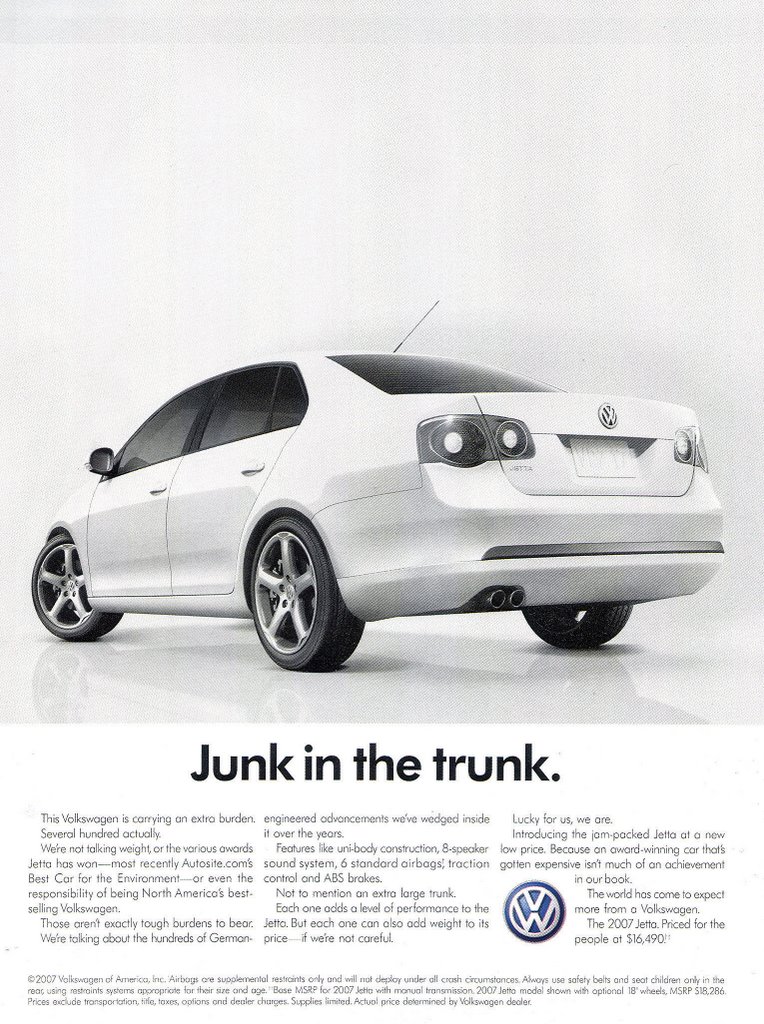 ads. Not just because they have nothing to prove creatively, but because someone there actually knows how to write.
The copy sells hard but gracefully and is 100% bullshit-free. The style is literate and witty but in no way condescending or snarky. If Crispin does wind up losing this business, it will be a shame. These ads are the real deal.
Tuesday, February 13, 2007
Dogs rule. BMWs suck.
So I'm watching the Westminster Dog Show, which, given the...um..specialized nature of its audience, has lots of commercials featuring dogs.
Most of these commercials are for Pedigree, and they're great. Of course, when the brief is to encourage people to donate to a dog-rescue fund, and the audience by definition loves dogs, if you can't do a nice spot you should just give it up. Dogs rule, indeed.
And then this BMW spot comes on. Guy whistles for his Weimariner to go out for a spin. Dog looks dubious. Dog exits frame, reappears wearing a crash helmet. Now he looks dubious and ashamed. Against his better judgment, dog hops into back of BMW wagon. Guy stomps on the accelerator, hurling his dog against the rear windshield as he peels out of the driveway.
Nice creative choice to run on a dog show, guys. Note to dogs waiting for new owners in shelters: if someone comes in and jangles BMW keys at you...bite him. You're better off where you are.
Most of these commercials are for Pedigree, and they're great. Of course, when the brief is to encourage people to donate to a dog-rescue fund, and the audience by definition loves dogs, if you can't do a nice spot you should just give it up. Dogs rule, indeed.
And then this BMW spot comes on. Guy whistles for his Weimariner to go out for a spin. Dog looks dubious. Dog exits frame, reappears wearing a crash helmet. Now he looks dubious and ashamed. Against his better judgment, dog hops into back of BMW wagon. Guy stomps on the accelerator, hurling his dog against the rear windshield as he peels out of the driveway.
Nice creative choice to run on a dog show, guys. Note to dogs waiting for new owners in shelters: if someone comes in and jangles BMW keys at you...bite him. You're better off where you are.
Tuesday, February 06, 2007
Super Bowl Bench Warmers
I think the big winners and losers have been pretty well documented, don't you?
I'm sickly drawn in this post to the ads consigned to Purgatory, neither praised nor derided. I'm fascinated by the forgettable. If you're going to pay $2.5 MM to air a spot, at least try. Take a shot. Fail Big, like Snickers or Garmin. But no. Anyone remember these?
Ford F 150. Lots of parts coming together to make...um...a truck. Like Honda's "Cog" with all the coolness stripped away.
Prudential. Rocks are good for skipping. Rocks are good for massage. Rocks are good for...let me guess...I feel it coming...insurance.
Ford Edge. Let's see, the vehicle's name is "Edge" so let's have it ride (in clumsy CGI) on the edge. And have some rocker sing "I like to live on the edge." Which means, of course, that he doesn't.
And my grand prix for Forgetability, the least remembered, least-talked about spot on the Super Bowl:
PNC Bank. They ran the pitch mood piece. Aimless vignettes of people walking, children smiling, people tapping on keyboads...what--you don't remember? What about when the AVO talked about helping you meet your goals and your dreams? No? Surely you remember the line at the end:
PNC. Leading the way.
I did. Which is deeply troubling.
I'm sickly drawn in this post to the ads consigned to Purgatory, neither praised nor derided. I'm fascinated by the forgettable. If you're going to pay $2.5 MM to air a spot, at least try. Take a shot. Fail Big, like Snickers or Garmin. But no. Anyone remember these?
Ford F 150. Lots of parts coming together to make...um...a truck. Like Honda's "Cog" with all the coolness stripped away.
Prudential. Rocks are good for skipping. Rocks are good for massage. Rocks are good for...let me guess...I feel it coming...insurance.
Ford Edge. Let's see, the vehicle's name is "Edge" so let's have it ride (in clumsy CGI) on the edge. And have some rocker sing "I like to live on the edge." Which means, of course, that he doesn't.
And my grand prix for Forgetability, the least remembered, least-talked about spot on the Super Bowl:
PNC Bank. They ran the pitch mood piece. Aimless vignettes of people walking, children smiling, people tapping on keyboads...what--you don't remember? What about when the AVO talked about helping you meet your goals and your dreams? No? Surely you remember the line at the end:
PNC. Leading the way.
I did. Which is deeply troubling.
Tuesday, January 30, 2007
Taking it to focus groups. That's the hard part.
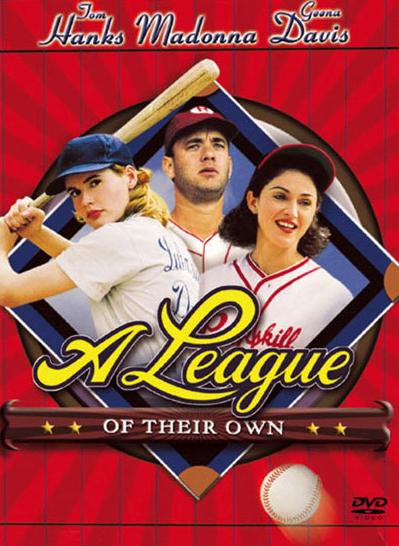
You know that scene in “A League of Their Own” where Gina Davis decides to hang up her cleats after hubby Bill Pullman comes home from the war? Where she tells Tom Hanks that playing pro baseball was just too hard? Hanks looks at her in disgust and says “It’s supposed to be hard. If it was easy, everyone could do it.”
Well, I just took a look at the 5 final “consumer-generated” Doritos spots for the Superbowl, and you know what?
Apparently, everyone can do it. As George Parker pointed out, these are not bad spots. (Well, "Live the Flavor” is a pretty bad spot but the other 4 are pretty good.)
And as any number of people have pointed out (and others, including me, predicted), the people who created them are not exactly amateurs. They are art school students, aspiring filmmakers etc.
But as I watched the spots, I was struck by something else. These spots were not only pretty professional-looking, they all had the distinct feel of Superbowl spots…that sort of BBDO/DDB jokey-hyerbolic comedic style. The guy who duct-tapes his roommate to keep him away from the bag of Doritos. The rock climber who loses his grip because he’s clutching a bag of Doritos.
This is old school TV creative. Not bad. But not new. If you showed it to David Lubars he’d kick you out of his office. And this is the future of advertising? Having people who are trying to break into the business do work none of us would view as fresh?
Monday, January 22, 2007
Age and Advertising, Part Two
Literature is strewn with examples of writers creating and inhabiting characters totally unlike themselves. James Joyce’s Molly Bloom... Michael Haddon's autistic Christopher Boone... characters like these are so convincingly wrought, they stand as feats of pure imagination.
And then there’s advertising.
Walk around any creative department and it’s 1955. Women (and gay men) work on cosmetics. Men work on cars. Young men work on beer. Middle-aged creatives, what few there are, are in management or herded off to work on pharma.
Defenders of this caste system invoke the “Write about what you know” approach, saying (if not necessarily believing) that creatives whose age and gender mirror the target group will have better “insights” that “resonate” at a deeper level.
Excuse me, but how insightful do you have to be to introduce a new stuffed-crust pizza? And anyway, aren’t the “insights”--so hard-won in endless rounds of focus groups—already there on the brief?
Off the record, agency managers will tell you that client comfort has a lot to do with it too. I have a very good friend who lost her job working—of course—on a feminine hygiene product account when a new client decided she was too old.
Talk about double jeopardy!
Let’s suppose, just for a moment, that casting by age for different types of accounts makes sense. Let’s say you have the Red Bull business. Do you really want a 50+ creative working on it? Speaking personally, there’s no part of my life that requires knocking back a lethal shot of caffeine at 2 AM. None. The only thing that’s going to give me wings at this point is going to the Hereafter.
So fine: to work on a young person’s product it sometimes helps to be young. But now let’s turn the question around. To work on an older person’s product, does it help to be older?
This is where things get fucked up. Because the typecasting only runs in one direction. No one has a problem with a 28-year-old creative working on life insurance, cognac, luxury sedans or (women only please) wrinkle cream. But maybe they should.
Just as there are ads—I’m sorry, I mean branded consumer engagement content—that are totally five minutes ago for their 20-something target, there are also ads that are hilariously wrong for their 55-year-old customer.
Here’s a good rule of thumb:
If you are someone who still sees a role for Red Bull in your life, you have no insight into life insurance.
And then there’s advertising.
Walk around any creative department and it’s 1955. Women (and gay men) work on cosmetics. Men work on cars. Young men work on beer. Middle-aged creatives, what few there are, are in management or herded off to work on pharma.
Defenders of this caste system invoke the “Write about what you know” approach, saying (if not necessarily believing) that creatives whose age and gender mirror the target group will have better “insights” that “resonate” at a deeper level.
Excuse me, but how insightful do you have to be to introduce a new stuffed-crust pizza? And anyway, aren’t the “insights”--so hard-won in endless rounds of focus groups—already there on the brief?
Off the record, agency managers will tell you that client comfort has a lot to do with it too. I have a very good friend who lost her job working—of course—on a feminine hygiene product account when a new client decided she was too old.
Talk about double jeopardy!
Let’s suppose, just for a moment, that casting by age for different types of accounts makes sense. Let’s say you have the Red Bull business. Do you really want a 50+ creative working on it? Speaking personally, there’s no part of my life that requires knocking back a lethal shot of caffeine at 2 AM. None. The only thing that’s going to give me wings at this point is going to the Hereafter.
So fine: to work on a young person’s product it sometimes helps to be young. But now let’s turn the question around. To work on an older person’s product, does it help to be older?
This is where things get fucked up. Because the typecasting only runs in one direction. No one has a problem with a 28-year-old creative working on life insurance, cognac, luxury sedans or (women only please) wrinkle cream. But maybe they should.
Just as there are ads—I’m sorry, I mean branded consumer engagement content—that are totally five minutes ago for their 20-something target, there are also ads that are hilariously wrong for their 55-year-old customer.
Here’s a good rule of thumb:
If you are someone who still sees a role for Red Bull in your life, you have no insight into life insurance.
Saturday, January 20, 2007
The plant tour
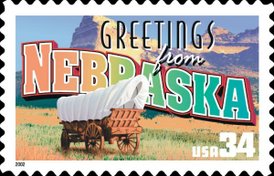
Yesterday I got on my client’s corporate jet and flew to Nebraska to take the plant tour, thereby violating Fenske’s Anti-Law #9.
What can I say? Private jets are fun, even when you’re going to a factory in Nebraska in January. It’s like my children, when they were little: they thought the coolest part of any trip, whether it was DisneyWorld or the Berkshires or LA, was room service.
Clients like creatives to take the plant tour because there’s the possibility they’ll see something there to inspire them creatively; also maybe because they secretly delight in seeing smartypants hipsters so far out of their comfort zones. But the truth is, beyond a certain point, additional knowledge about how a product is made isn’t usually helpful. It either bores people or tears away their illusions (e.g., hot dogs).
Still, spending a day with people who live outside the irony zone and care to an incredible degree about making the best product they can, can get a guy pretty motivated about making ads, so going on the plant tour accomplished its goal, if not in the way the client intended.
Tuesday, December 19, 2006
Embedding an idea in shit doesn't make it viral.
Bad ads get ignored.
Good ads get noticed.
Great ads go viral.
And they always have. The difference is, people used to say "Did you see that commercial last night?'" and now they just put it up on YouTube.
The Dove transformation spot would have been talked about and shared 20 years ago.
"Where's the beef?" would be getting a zillion hits on YouTube if it had debuted last week.
Either way, a meme is replicating itself through the culture. Same process, new petri dish.
Good ads get noticed.
Great ads go viral.
And they always have. The difference is, people used to say "Did you see that commercial last night?'" and now they just put it up on YouTube.
The Dove transformation spot would have been talked about and shared 20 years ago.
"Where's the beef?" would be getting a zillion hits on YouTube if it had debuted last week.
Either way, a meme is replicating itself through the culture. Same process, new petri dish.
Wednesday, December 13, 2006
What I learned from the 2006 CA Advertising Annual
The Communication Arts Advertising Annual arrived yesterday and I fell upon it eagerly. Here is what I’ve learned:
1. If you want to do award-winning work, move to Singapore.
2. Everywhere but in the US, board games appear to be the most heavily advertised consumer product. That or Legos.
3. Contrary to what your account supervisor told you, 4-color spreads make good sense and are affordable for every client, regardless of budget.
4. A new agency can get into the CA Annual executing the old agency’s campaign (see pages 30 & 66).
5. Procter & Gamble can and will buy great work (Tide to Go, Cascade).
6. They will also buy incomprehensible dreck (Folgers) if you let them.
7. Radio is (and maybe always will be) your best shot at winning.
8. If there are no jobs in Singapore, move to Bangkok.
1. If you want to do award-winning work, move to Singapore.
2. Everywhere but in the US, board games appear to be the most heavily advertised consumer product. That or Legos.
3. Contrary to what your account supervisor told you, 4-color spreads make good sense and are affordable for every client, regardless of budget.
4. A new agency can get into the CA Annual executing the old agency’s campaign (see pages 30 & 66).
5. Procter & Gamble can and will buy great work (Tide to Go, Cascade).
6. They will also buy incomprehensible dreck (Folgers) if you let them.
7. Radio is (and maybe always will be) your best shot at winning.
8. If there are no jobs in Singapore, move to Bangkok.
Friday, December 08, 2006
Change agents and the agencies they love.

If you’re going to flush your career down the toilet, are you really going to do it for this guy?
Just because he has an Aston Martin doesn’t make him Sean Connery. No matter how many cups of Nobu’s house sake you’ve downed.
Wal-Mart Fires Marketing Star and Ad Agency - New York Times
Monday, December 04, 2006
Arts and Crafts
Enough about art.
I’m here to talk about craft.
Not the Martha and her hot-glue gun kind of craft.
Or those dreadful outdoor fairs filled with stained-glass wine coasters and Labrador retrievers made out of macramé.
No, I’m talking about the look-how-beautifully-everything-fits-together kind of craft.
The first-you-make-the-sushi-rice-for-seven-years-and-then-you-can-slice-the-fish kind of craft.
And my point is that while a few ads do legitimately aspire to the level of art, craft is what keeps hundreds of ads every year from outright sucking.
Say “craft” to many in our business and the image that comes to mind is the prima donna sociopath, endlessly re-kerning type while the traffic manager flips out. If there’s someone like that at your agency, he may or may not be an artist. But he’s not a craftsman.*
Real craftsmen have a smoothness, an economy of thought and movement, that tempers their obsessive attention to detail. “Measure twice, cut once,” as the carpenter’s maxim goes.
Here are some other differences between art and craft:
Artists want—no, need-- their creation to be new and original.
Craftsmen have different, more immediate worries. Is it well-made? Is it honest? Does it work? Will it wear well?
The joy of art is in the conceiving and the beholding. The joy of craft is in the making.
Artists sign their work. Craftsmen do their work, and if they do it well and long enough, the work itself becomes a calling card.
Art is high-maintenance. Who does the maintaining? Craftsmen.
Art concerns itself with Big Things. Craft is democratic. Small-space trade ads, national TV campaigns, they all are things to be crafted. And if anything, the craft shines more brightly in the dark recesses of the obscure trade journal than in the glare of prime time.
Because, let’s face it, not a lot of people notice.
Only stubborn pride in craft compels an art director to slave over all those nasty titles in the Summer Sales Event spot so they come out clean and graphically coherent.
Meter, rhythm, syntax—if they’re in that bank-ad body copy at all, it’s because a craft-obsessed writer put them there.
That’s why, if I were a client, and I had to choose whether artists or craftsmen worked on my business, it would be such a no-brainer. It’s like asking a homeowner about to do a major addition whether he’d rather have Frank Gehry or Norm Abrams from “This Old House.”
Hell, I bet even Frank Gehry would rather have Norm.
*Apologies upfront to female practitioners. Craftsperson? Craftswoman? The language hasn’t caught up to the reality of your skills.
I’m here to talk about craft.
Not the Martha and her hot-glue gun kind of craft.
Or those dreadful outdoor fairs filled with stained-glass wine coasters and Labrador retrievers made out of macramé.
No, I’m talking about the look-how-beautifully-everything-fits-together kind of craft.
The first-you-make-the-sushi-rice-for-seven-years-and-then-you-can-slice-the-fish kind of craft.
And my point is that while a few ads do legitimately aspire to the level of art, craft is what keeps hundreds of ads every year from outright sucking.
Say “craft” to many in our business and the image that comes to mind is the prima donna sociopath, endlessly re-kerning type while the traffic manager flips out. If there’s someone like that at your agency, he may or may not be an artist. But he’s not a craftsman.*
Real craftsmen have a smoothness, an economy of thought and movement, that tempers their obsessive attention to detail. “Measure twice, cut once,” as the carpenter’s maxim goes.
Here are some other differences between art and craft:
Artists want—no, need-- their creation to be new and original.
Craftsmen have different, more immediate worries. Is it well-made? Is it honest? Does it work? Will it wear well?
The joy of art is in the conceiving and the beholding. The joy of craft is in the making.
Artists sign their work. Craftsmen do their work, and if they do it well and long enough, the work itself becomes a calling card.
Art is high-maintenance. Who does the maintaining? Craftsmen.
Art concerns itself with Big Things. Craft is democratic. Small-space trade ads, national TV campaigns, they all are things to be crafted. And if anything, the craft shines more brightly in the dark recesses of the obscure trade journal than in the glare of prime time.
Because, let’s face it, not a lot of people notice.
Only stubborn pride in craft compels an art director to slave over all those nasty titles in the Summer Sales Event spot so they come out clean and graphically coherent.
Meter, rhythm, syntax—if they’re in that bank-ad body copy at all, it’s because a craft-obsessed writer put them there.
That’s why, if I were a client, and I had to choose whether artists or craftsmen worked on my business, it would be such a no-brainer. It’s like asking a homeowner about to do a major addition whether he’d rather have Frank Gehry or Norm Abrams from “This Old House.”
Hell, I bet even Frank Gehry would rather have Norm.
*Apologies upfront to female practitioners. Craftsperson? Craftswoman? The language hasn’t caught up to the reality of your skills.
Subscribe to:
Posts (Atom)
