This morning’s Stuart Elliot column in the NYT is grisly/funny evidence of what happens if you try to talk about advertising to journalists (even careful, knowledgeable ones like Stuart). You wind up saying things like this:
“I didn’t pop my head out of a focus-group room in 6 weeks.” And: “This audience doesn’t want to be advertised to.” (Others do?) And besides: if this audience has a particular loathing for advertising, grilling them in focus-group rooms for six weeks about which “concept” they like will teach you what, exactly?
This: “[This audience] doesn’t want to be told what to do. ‘Free to be’ says ‘you can be anything you want to be and you’re welcome at the CW.’”
(“Free to Be,” by the way, is the CW network’s new theme/strategy, and is yet another great instance of David Nottoli’s Tyranny of Consumer Insight point discussed in my last post.)
I have this vision of this guy’s PR handler sitting in the office, pleading with his eyes for the guy to stop, please stop, omigod please stop, while Stuart calmly sits there, writing down these bon mots verbatim.
Because here’s the deal: talking about advertising to civilians makes you sound like an idiot. That doesn’t mean that advertising is idiotic per se, although all manner of stupid things are said and done in our business every day. It just means it doesn’t translate well to people who are not compelled to drink whatever flavor of Kool-Aid you’re chugging.
While talking about advertising can make anyone look like an idiot, it seems to take its heaviest toll on client marketing execs like this guy from the CW network. Creatives, in general, are too introspective and paranoid to say anything ridiculous, although the ECD on this CW campaign waxed pretty poetic about the color green in the same article. Senior agency account managers don’t want to commit career seppuku by being more quotable than their client.
So that leaves poor Mr. or Ms. Sr. VP-Marketing to tell us why their new ad campaign will rock our world. Some cautiously opt to utter something unoriginal like “We felt we needed to cut through the clutter” in order to try to at least containthe damage.
For those desiring to go beyond the old clichés, the temptation is to put on that new-media-pioneer hat: “We wanted to find innovative new ways to engage our consumer” etc. etc.
And if that’s too tame, you can actually try to explain, as the hapless guy from the CW did, why your new advertising is a great idea. But if I were you, I wouldn’t. Nothing good can come of it.
Instead, I would do what generations of creatives, faced with the absurdity of articulating why they picked this typeface or that color, have done: gesture to the layouts or the roughcut or whatever, and say:
I think the work pretty much speaks for itself.
Friday, August 25, 2006


Friday, August 18, 2006
Garbage in, garbage out, garbage all around
Sidewalk Life: The Tyranny of Consumer Insights
David Nottoli makes a dead-on observation in this post from his excellent blog. For any creative who ever wondered why the briefs for the new deodorant, the online banking service and the fast-casual restaurant chain all have the same consumer insight, this is why.
David Nottoli makes a dead-on observation in this post from his excellent blog. For any creative who ever wondered why the briefs for the new deodorant, the online banking service and the fast-casual restaurant chain all have the same consumer insight, this is why.
Wednesday, August 09, 2006
63%? I'll take it.
Advertising Age - New Book Reports 37% of All Advertising Is Wasted
Well, I know everyone is riffing off this news as confirmation of Wanamaker's old crack about advertising, but for Chrissakes--63% of advertising works? I'll take it.
30% gets you to the Hall of Fame in baseball. Success of new product introductions? Around 10% or less. Marriage success rate in the family-values lovin' U.S. of A is around 50%.
Think about it: 63% of all the ads you see--mere images and words about foot odor and insurance and hamburger joints, competing for your attention with other unsought commercial messages as well as whatever content you're actually trying to look at or read...do what they're supposed to do.
If our industry wasn't so drenched in self-loathing, we'd view this as vindication, not embarassment.
Well, I know everyone is riffing off this news as confirmation of Wanamaker's old crack about advertising, but for Chrissakes--63% of advertising works? I'll take it.
30% gets you to the Hall of Fame in baseball. Success of new product introductions? Around 10% or less. Marriage success rate in the family-values lovin' U.S. of A is around 50%.
Think about it: 63% of all the ads you see--mere images and words about foot odor and insurance and hamburger joints, competing for your attention with other unsought commercial messages as well as whatever content you're actually trying to look at or read...do what they're supposed to do.
If our industry wasn't so drenched in self-loathing, we'd view this as vindication, not embarassment.
Tuesday, August 01, 2006
I know nottink!

I’m guessing that Dieter Zetsche is smart, down-to-earth and charming in person. I’m also guessing that becoming his company’s spokes-mens
 ch was not his idea.
But turning him into an alternately terrifying and clownish Teutonic tool—whose idea was that?
Sometimes, the best thing a creative can do for the work is to just get the hell out of the way.
Thursday, July 27, 2006
It's not easy pretending to be Green

What is it about doing “look how green we are” corporate ads that drives companies to make up ridiculous terms for what they’re doing?
First GE came up with “ecomagination,” which, given the company’s history with PCBs in the Hudson River, must mean “our imaginary ecological commitment.” Or maybe it means “it takes a hell of an imagination to call our coal-mining technology ecologically sensitive.”
Now Honda is jumping in with “enviromentology.” So silly—and so unnecessary, because Honda has been a leader in fuel efficiency and cleaner emissions for decades.
Curiously, the copy leads off with some belligerent noise about preferring to let the company’s actions speak for themselves rather than just writing about it. But, ummm, you are writing about it.
Here’s a thought: rather than “enviromentology” and “ecomagination,” why not just call it what it is: trying to do the right thing.
I say “trying” because the dominant color when it comes to balancing a company’s roles as profit engine and corporate citizen is not g
 reen. It’s gray. The trade-offs are complicated and the win-wins are infrequent. And I say this as a spotted-owl-kissing, dam-blowing, Nature Conservancy-giving greenie.
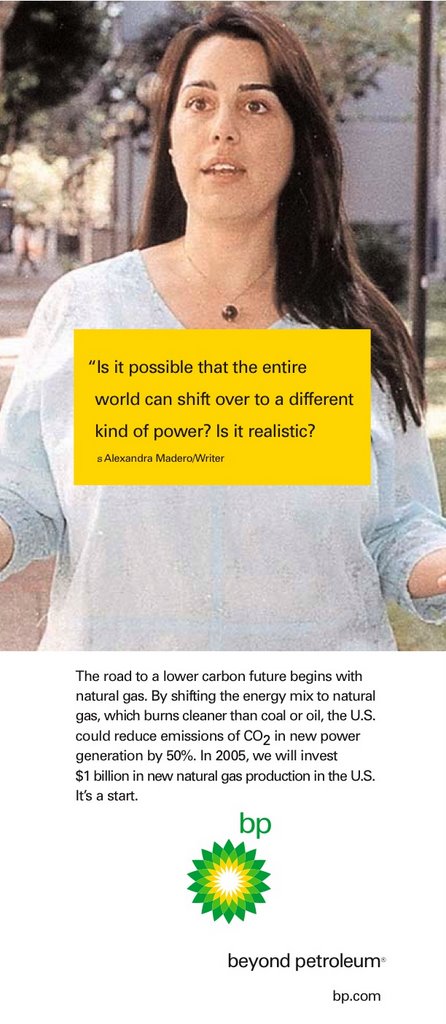
That’s why I respect BP’s take on environmental issues and responsibilities. It’s full of nuance and shades of gray (even when they highlight the buzzwords in yellow), and notably short on easy answers. I think they’re trying, and that—not an overactive ecomagination—is what counts.
Sunday, July 16, 2006
A different kind of cool.
A week spent flyfishing in the Canadian Rockies empties the mind of most thoughts about advertising. Which allowed this thought to find its way in:
We coastal sophisticates use irony to keep an emotional distance and to avoid embarrassing displays of enthusiasm and happiness.
Southwestern Alberta, however, is a 100% irony-free zone, and it’s like breathing pure oxygen—utterly refreshing and slightly giddy-making. So how do flyfishing guides, who are among the coolest people anywhere, keep their cool in the face of jaw-dropping scenery and 24-inch trout?
Understatement.
“Pretty nice sky, there, don’t you think?”
“Decent fish you got there.”
We in the ad business could use more understatement and less irony. Is the advertising world ready for “Introducing a new truck that's not half bad”?
I don’t know. But we’d feel better. We’d be less ironic. And we’d be a whole lot better-liked.
We coastal sophisticates use irony to keep an emotional distance and to avoid embarrassing displays of enthusiasm and happiness.
Southwestern Alberta, however, is a 100% irony-free zone, and it’s like breathing pure oxygen—utterly refreshing and slightly giddy-making. So how do flyfishing guides, who are among the coolest people anywhere, keep their cool in the face of jaw-dropping scenery and 24-inch trout?
Understatement.
“Pretty nice sky, there, don’t you think?”
“Decent fish you got there.”
We in the ad business could use more understatement and less irony. Is the advertising world ready for “Introducing a new truck that's not half bad”?
I don’t know. But we’d feel better. We’d be less ironic. And we’d be a whole lot better-liked.
Wednesday, July 12, 2006
The arc.
Agency-client relationships have an arc, just like movie plots and short-lived romances. The arc typically has five points:
Admiration.
Infatuation.
Habituation.
Alienation.
Termination.
Let’s look at each one, and for you agency young ‘uns who haven’t traversed a full arc yet, don’t despair. Sometimes these things can stay at Habituation for years.
Admiration. The client starts to hear about a new shop. Maybe he reads a trade magazine article. Or he meets the creative director. Or maybe he sees an ad he likes and tracks down the shop responsible. Whatever. He goes to the agency’s web site and likes what he sees. He asks around and likes what he hears. He googles the agency’s principals. He finds himself daydreaming about working with this new shop. His current shop doesn’t know it yet, but they’re toast.
Infatuation. With or without the pretense of a review, the client has consummated his relationship with the new agency. The people--they’re so bright and shiny and new! And their ideas—so bold! Their media plans—so nontraditional! Where have these people been all my life? And the wrap party for the anthem spot? Dude!
Habituation. He can’t remember exactly when. It was such a gradual thing. One day, the process was a smoothly-running machine. Everyone on the same page, deadlines all getting met. The next day: a kind of comfortable boredom. Business as usual. Not in a bad way—we’ve got a total Vulcan mind-meld going. But do the senses tingle? No they do not.
Alienation. If the client saw one more podcast-driven idea, he was going to scream. The art director’s piercings were no longer exciting—they were tiresome. The Account Supe’s verbal tics—were they ever endearing? He thinks maybe once. But not now. Every flaw, every glitch seemed to be magnified, like zits in a make-up mirror. And that franchise meeting where the new campaign was shown? What a nightmare!
Termination. What was the name of that agency the West Coast sales manager was talking about last night? They sounded kind of cool. Wonder what their site looks like.
Wow. Very cool. Wonder if this is the right time to make a change?
That’s right—it’s the Great Circle of Life. One agency’s alienated client is another agency’s smitten stalker.
Admiration.
Infatuation.
Habituation.
Alienation.
Termination.
Let’s look at each one, and for you agency young ‘uns who haven’t traversed a full arc yet, don’t despair. Sometimes these things can stay at Habituation for years.
Admiration. The client starts to hear about a new shop. Maybe he reads a trade magazine article. Or he meets the creative director. Or maybe he sees an ad he likes and tracks down the shop responsible. Whatever. He goes to the agency’s web site and likes what he sees. He asks around and likes what he hears. He googles the agency’s principals. He finds himself daydreaming about working with this new shop. His current shop doesn’t know it yet, but they’re toast.
Infatuation. With or without the pretense of a review, the client has consummated his relationship with the new agency. The people--they’re so bright and shiny and new! And their ideas—so bold! Their media plans—so nontraditional! Where have these people been all my life? And the wrap party for the anthem spot? Dude!
Habituation. He can’t remember exactly when. It was such a gradual thing. One day, the process was a smoothly-running machine. Everyone on the same page, deadlines all getting met. The next day: a kind of comfortable boredom. Business as usual. Not in a bad way—we’ve got a total Vulcan mind-meld going. But do the senses tingle? No they do not.
Alienation. If the client saw one more podcast-driven idea, he was going to scream. The art director’s piercings were no longer exciting—they were tiresome. The Account Supe’s verbal tics—were they ever endearing? He thinks maybe once. But not now. Every flaw, every glitch seemed to be magnified, like zits in a make-up mirror. And that franchise meeting where the new campaign was shown? What a nightmare!
Termination. What was the name of that agency the West Coast sales manager was talking about last night? They sounded kind of cool. Wonder what their site looks like.
Wow. Very cool. Wonder if this is the right time to make a change?
That’s right—it’s the Great Circle of Life. One agency’s alienated client is another agency’s smitten stalker.
Friday, June 23, 2006
If, It, whatever.
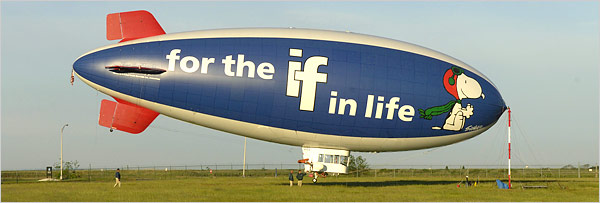
Has anyone else noticed the remarkable resemblance between Met Life's new "If" campaign and eBay's "It" work?
Squint slightly, or have a couple of mojitos, and the two ads will appear identical...each with two giant, Stonehenge-like letters dominating the page.

Seems to me they'd be better off swapping, though. Wouldn't Met Life rather be about "it" than "if"? So much more certain-sounding. And wouldn't eBay's serendipitous nature be nicely captured by "if"?
Wednesday, June 14, 2006
I'm sorry, what was the question?
An ad currently running for the Lexus ES starts off with this headline-as-question:
“Is it possible to engineer desire?”
I’m guessing the answer they’re looking for is yes-- even though the copy never says so--and that the Lexus ES is proof. Well, fine, this wouldn’t be the first car ad that tries to juxtapose emotion and science, heart and steel, etc etc etc.
But that just makes this execution derivative.
What vaults it past derivative to silly is that question mark. It’s that school of thought that says “Don’t just tell people things. Ask them instead—it’s more involving.” Ask the right question--Allstate's "Are you in good hands?" comes to mind--and the effect can be unsettling...or illuminating...but never boring. But ask the wrong question and the opposite happens. What better way to signal you know nothing about me and don't care to learn than to ask me a question I see no reason to answer? Here’s another example, for a new Canon DSLR:
“When Canon created the new EOS 30D, what were they thinking?”
I don’t know. I don’t care. But what was that copywriter thinking? That the implied meaning—Canon’s done something terrible, Canon’s gone off its rocker—would give this ad a frisson of danger?
Lawyers have a sacred rule when it comes to courtroom witness examination:
Never ask a question you don’t already know the answer to. The object, obviously, is to maintain control, avoid surprises and keep a witness from going in an unproductive direction.
Copywriters might consider a different rule: Never ask a question if people don’t care what the answer is.
“Is it possible to engineer desire?”
I’m guessing the answer they’re looking for is yes-- even though the copy never says so--and that the Lexus ES is proof. Well, fine, this wouldn’t be the first car ad that tries to juxtapose emotion and science, heart and steel, etc etc etc.
But that just makes this execution derivative.
What vaults it past derivative to silly is that question mark. It’s that school of thought that says “Don’t just tell people things. Ask them instead—it’s more involving.” Ask the right question--Allstate's "Are you in good hands?" comes to mind--and the effect can be unsettling...or illuminating...but never boring. But ask the wrong question and the opposite happens. What better way to signal you know nothing about me and don't care to learn than to ask me a question I see no reason to answer? Here’s another example, for a new Canon DSLR:
“When Canon created the new EOS 30D, what were they thinking?”
I don’t know. I don’t care. But what was that copywriter thinking? That the implied meaning—Canon’s done something terrible, Canon’s gone off its rocker—would give this ad a frisson of danger?
Lawyers have a sacred rule when it comes to courtroom witness examination:
Never ask a question you don’t already know the answer to. The object, obviously, is to maintain control, avoid surprises and keep a witness from going in an unproductive direction.
Copywriters might consider a different rule: Never ask a question if people don’t care what the answer is.
Monday, June 05, 2006
How to be a better client.
There's an old saying in this business that clients get the advertising they deserve. Here are some things they don't teach in business school or discuss in marketing conferences that can increase the odds you'll get your agency's best efforts--and deserve them.
Don’t buy a dog and then bark for it. The reason you hire an ad agency is because their people can do things you can’t. Tell your agency team what your advertising needs to do, agree on how you’re going to measure it, then let them work. Telling advertising professionals how to do their job wastes their talents and your company’s money.
Value our Otherness. While an agency needs to understand its client’s culture, business model and products, they are not you. That difference is valuable. There’s already an expert on your company and its products and it’s you.
Be straight with us. All companies have politics. All employees have bosses. If either one is the reason you’re reluctant to embrace a good idea, tell us. We will respect you, empathize and work with you to deal with the problem. If you don’t tell us, we’ll have no choice but to think you don’t know a good idea when you see one.
Do not ask: Is there a better shot/take/word/phrase/layout? The creatives don’t think there is, or you would have already seen it.
Get out from behind the glass. You’re a successful young professional. Living someone else’s life, even for a few minutes, beats watching it every time. Go to a NASCAR race (not comped). Watch Fox. If you already watch Fox, listen to NPR. Walk around a neighborhood you don’t know. Eavesdrop, always. And whatever you do, when looking at the agency’s work…
Don’t think like a marketer. You were born with all the training you need to look at an ad and figure out if it’s good. Your humanity and your life experiences will steer you right. The minute you start analyzing, you’re in trouble.
Don’t buy a dog and then bark for it. The reason you hire an ad agency is because their people can do things you can’t. Tell your agency team what your advertising needs to do, agree on how you’re going to measure it, then let them work. Telling advertising professionals how to do their job wastes their talents and your company’s money.
Value our Otherness. While an agency needs to understand its client’s culture, business model and products, they are not you. That difference is valuable. There’s already an expert on your company and its products and it’s you.
Be straight with us. All companies have politics. All employees have bosses. If either one is the reason you’re reluctant to embrace a good idea, tell us. We will respect you, empathize and work with you to deal with the problem. If you don’t tell us, we’ll have no choice but to think you don’t know a good idea when you see one.
Do not ask: Is there a better shot/take/word/phrase/layout? The creatives don’t think there is, or you would have already seen it.
Get out from behind the glass. You’re a successful young professional. Living someone else’s life, even for a few minutes, beats watching it every time. Go to a NASCAR race (not comped). Watch Fox. If you already watch Fox, listen to NPR. Walk around a neighborhood you don’t know. Eavesdrop, always. And whatever you do, when looking at the agency’s work…
Don’t think like a marketer. You were born with all the training you need to look at an ad and figure out if it’s good. Your humanity and your life experiences will steer you right. The minute you start analyzing, you’re in trouble.
Monday, May 22, 2006
Nothing claims better than...a claim.
All the shit that used to work
Don’t work now.
--Warren Zevon, “My Shit’s Fucked Up”
What is it about claims? What is the power of its siren call to clients of all stripes?
Why must everything be stronger, longer and preferred 3 to 1? How is that even possible? Some advertising domains, like wireless phone service, automotive and analgesics, seem to inhabit a parallel universe in which the laws of statistics don’t apply—everything’s above average, like Garrison Keilor’s children of Lake Woebegone.
Back in the day, claims were the backbone of that package-goods stalwart, the Reason To Believe. They were a mashup of engineering and marketing, written to make sense to civilians but still trailing their cloak of numbers and percentages from the lab. And mostly, they worked.
So the claims-driven model was exported out of the world of detergents into other arenas, often with bizarre results. I remember a Procter & Gamble client in the early 80s, during a brief, unhappy period when the company was dabbling in the soft drink business, telling me excitedly he had data to support the claim that Orange Crush was preferred to Coke by Coke drinkers.
Never mind that this was an oranges-to-cola-nuts comparison, or that if it actually mattered, Crush’s market share wouldn’t be one hundredth of Coke’s. No, this finding demanded an enthusiastic Damn-let’s-run-with-it! kind of answer.
“So?” I asked.
Not the best response, but what was true then is (here’s a claim for you) even truer now. Maybe forty percent more!
Now that anyone (assuming they cared to) could get 2 zillion user’s ratings, expert opinions and blog reviews to compare to a company’s stated claim with one mouse-click, “Nothing works better” doesn’t work as well as it used to. You say you have fewer dropped calls? That’s not what CNet says! Or Jacko in the mycellphonetotallysucks.com chatroom.
I’m using wireless service providers as an example partly because an article in the New York Times last week pointed to one reason why old-fashioned claims still make%
Don’t work now.
--Warren Zevon, “My Shit’s Fucked Up”
What is it about claims? What is the power of its siren call to clients of all stripes?
Why must everything be stronger, longer and preferred 3 to 1? How is that even possible? Some advertising domains, like wireless phone service, automotive and analgesics, seem to inhabit a parallel universe in which the laws of statistics don’t apply—everything’s above average, like Garrison Keilor’s children of Lake Woebegone.
Back in the day, claims were the backbone of that package-goods stalwart, the Reason To Believe. They were a mashup of engineering and marketing, written to make sense to civilians but still trailing their cloak of numbers and percentages from the lab. And mostly, they worked.
So the claims-driven model was exported out of the world of detergents into other arenas, often with bizarre results. I remember a Procter & Gamble client in the early 80s, during a brief, unhappy period when the company was dabbling in the soft drink business, telling me excitedly he had data to support the claim that Orange Crush was preferred to Coke by Coke drinkers.
Never mind that this was an oranges-to-cola-nuts comparison, or that if it actually mattered, Crush’s market share wouldn’t be one hundredth of Coke’s. No, this finding demanded an enthusiastic Damn-let’s-run-with-it! kind of answer.
“So?” I asked.
Not the best response, but what was true then is (here’s a claim for you) even truer now. Maybe forty percent more!
Now that anyone (assuming they cared to) could get 2 zillion user’s ratings, expert opinions and blog reviews to compare to a company’s stated claim with one mouse-click, “Nothing works better” doesn’t work as well as it used to. You say you have fewer dropped calls? That’s not what CNet says! Or Jacko in the mycellphonetotallysucks.com chatroom.
I’m using wireless service providers as an example partly because an article in the New York Times last week pointed to one reason why old-fashioned claims still make%
Saturday, May 13, 2006
Rich off our backs! Wait--we are rich.
You know the guy you meet at your 25th college reunion who forces you through a Bataan death-march of reminiscences you don’t actually share?
“Hey man, remember that killer Michuocan bud we scored before the Jethro Tull concert? Or how about when I puked on your stereo during Homecoming? Good times, man, good times.”
You don’t actually remember any of it because that guy wasn’t really your friend in college—he was just some hanger-on looking to score free dope or pizza. You didn’t like him then and you don’t like him now.
That guy—let’s be frank: that asshole—is back and on our TV. The same bogus memories of shared psychedelic adventures. The same thinly disguised taker’s agenda. Except now he’s called Ameriprise.
Whoever created this disagreeable mess, shame on you.
Shame on you for thinking that showing me a ripomatic with clips from Woodstock, pictures of Che and kids with bad hairdos would induce me to roll my 401K into your outfit.
Shame on you for tarnishing images and music I associate with not caring about money with talk of wealth management.
That was then, this is now. Part of me never left Woodstock, but dude, I don’t remember seeing you there. And besides, I don’t want some stoner investing my life savings.
“Hey man, remember that killer Michuocan bud we scored before the Jethro Tull concert? Or how about when I puked on your stereo during Homecoming? Good times, man, good times.”
You don’t actually remember any of it because that guy wasn’t really your friend in college—he was just some hanger-on looking to score free dope or pizza. You didn’t like him then and you don’t like him now.
That guy—let’s be frank: that asshole—is back and on our TV. The same bogus memories of shared psychedelic adventures. The same thinly disguised taker’s agenda. Except now he’s called Ameriprise.
Whoever created this disagreeable mess, shame on you.
Shame on you for thinking that showing me a ripomatic with clips from Woodstock, pictures of Che and kids with bad hairdos would induce me to roll my 401K into your outfit.
Shame on you for tarnishing images and music I associate with not caring about money with talk of wealth management.
That was then, this is now. Part of me never left Woodstock, but dude, I don’t remember seeing you there. And besides, I don’t want some stoner investing my life savings.
Friday, May 12, 2006
Cooties.
For the few of you who read this blog with any regularity, my apologies for the lack of new postings.
I’m trying very hard to keep this thing from devolving into an Apple-hating rag, but a hard crash on a Unix-based system, while rare, is not a pretty sight. My spiffy new Intel-chip based MacBook Pro dove off the deep end last week and only emerged, functional but with a slight case of amnesia, this morning after a thorough scrubbing.
This new platform is a buggy little bastard, a lot less together in reality than the hipster holding hands with the PC dork in the new Apple spot. Many perceptive writers have already pointed out that this campaign is one of Apple’s periodic returns to Kool-Aid drinking.
In the commercial, it’s the PC that gets cooties. But if the dude/computer he’s holding hands with is an Intel Dual Core-based Mac, he better wash his hands but good.
P.S. Armando, my muy macho I.T. dude, says don’t install the OS 4.6 patch, whatever that is, in case you were thinking about it.
P.P.S. Yo, Apple: the switch-testimonial commercials directed by Errol Morris were the best Apple computer advertising ever. Make some more of those. If you run out, just run the stoner-girl one again.
I’m trying very hard to keep this thing from devolving into an Apple-hating rag, but a hard crash on a Unix-based system, while rare, is not a pretty sight. My spiffy new Intel-chip based MacBook Pro dove off the deep end last week and only emerged, functional but with a slight case of amnesia, this morning after a thorough scrubbing.
This new platform is a buggy little bastard, a lot less together in reality than the hipster holding hands with the PC dork in the new Apple spot. Many perceptive writers have already pointed out that this campaign is one of Apple’s periodic returns to Kool-Aid drinking.
In the commercial, it’s the PC that gets cooties. But if the dude/computer he’s holding hands with is an Intel Dual Core-based Mac, he better wash his hands but good.
P.S. Armando, my muy macho I.T. dude, says don’t install the OS 4.6 patch, whatever that is, in case you were thinking about it.
P.P.S. Yo, Apple: the switch-testimonial commercials directed by Errol Morris were the best Apple computer advertising ever. Make some more of those. If you run out, just run the stoner-girl one again.
Monday, April 24, 2006
Hot Pants!
This is supposed to be a blog about the making of ads, but since Macs are the computer of choice for 99.99% of creatives, let me put this out there:
Mac laptops run hot. Fry-your-thighs hot.
Apple was supposed to address this issue with the new Intel-powered laptops but as the proud owner of one, let me tell you: mission not accomplished.
So here's a product idea for someone to implement. I claim no intellectual rights. Make a thin, portable pad with high insulating qualities I can put between my MacBook Pro and my parboiled legs. I'll love you for it and so, I suspect, will a lot of other copywriters.
Mac laptops run hot. Fry-your-thighs hot.
Apple was supposed to address this issue with the new Intel-powered laptops but as the proud owner of one, let me tell you: mission not accomplished.
So here's a product idea for someone to implement. I claim no intellectual rights. Make a thin, portable pad with high insulating qualities I can put between my MacBook Pro and my parboiled legs. I'll love you for it and so, I suspect, will a lot of other copywriters.
Sunday, April 23, 2006
Insert visual pun here.
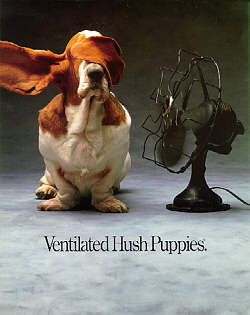
I think it all started with Hush Puppies.
In the late '80s, Fallon McElligott (yes, boys and girls, it was not always just Fallon) created a great campaign for the hopelessly dorky shoe brand in which an appropriately-propped basset hound stood in for whichever style was being featured.
(For a nice article about the genesis of this campaign, click here.)
But this approach—the visual pun—has, in the succeeding two decades, spread over and overwhelmed the worldwide advertising landscape like conceptual kudzu.
Open any issue of Archive at random and you’ll see ad after ad featuring a visual pun riffing off the brand name or the product’s function. In the lower right hand corner (often cropped to bleed off the page) is a logo or pack shot, sometimes coupled with a numbingly self-evident line of copy like “Kills Bugs” or “Sexy Lingerie.”
Here’s a recent example from the current issue:
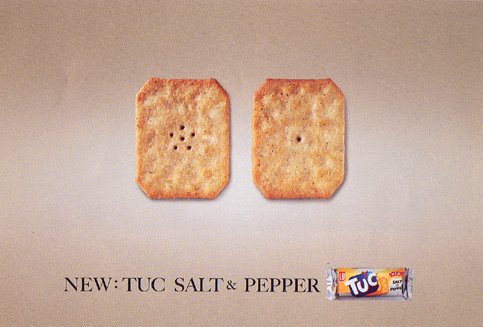
If you break this ad down, it is structurally exactly the same as the Hush Puppies ad. Portfolios coming out of the ad schools are just filled with layouts like this, no doubt because they tend to do well in the shows.
Many of the same young creatives who would gag and roll their eyes at 70s-era verbal puns (“A fresh approach to frozen peas”) think Photoshopping an insurance-company logo into the shape of a down comforter is kick-ass creative.
Puns, whether visual or verbal, are what they’ve always been: a lazy man’s way out. They require no understanding of the product or the people who might use it, substituting glibness for soul.
Except.
I can think of two good cases for exception. The first is when the pun lets you say something you can’t—or shouldn’t-- say straight up. The Hush Puppies work is a good example of this. Does anybody want see the literal version of ventilated shoes at work?
The second is when you’re not allowed to say anything. The long-running British Silk Cut campaign was a brilliant solution to this problem (it may actually pre-date the Hush Puppies work, and therefore be the Mother of All Visual Pun Campaigns).
These situations aside--and there aren’t that many of them, really—thinking of how your ad can be of some value in the world usually leads to better, more original work.
Sunday, April 16, 2006
Slogans than don't suck (1)
Can we just all stop for a second and bow down to whoever wrote
“When banks compete, you win” for Lending Tree?
It is a small miracle of copywriting.
First of all, it boils down a complicated process—a reverse auction in which financial vendors review your online credit application and credit history and generate a loan offer—into five words.
In the same five words, it makes it clear what the benefit is to you.
It’s written in perfect iambic meter, the da DUM cadence rolling right into your brain.
And it’s pitch-perfect in tone, neither overselling or underselling.
Gems like this don’t get much recognition in awards shows, or in creative circles in general. Lines or slogans are increasingly viewed as hopelessly passé, an afterthought for the client.
But even in this post-literate age, a well-crafted line is a meme not be trifled with.
Copywriters: there is no shame in the writing of a good slogan, even if there is no glory.
Clients: when your line rocks, you win.
“When banks compete, you win” for Lending Tree?
It is a small miracle of copywriting.
First of all, it boils down a complicated process—a reverse auction in which financial vendors review your online credit application and credit history and generate a loan offer—into five words.
In the same five words, it makes it clear what the benefit is to you.
It’s written in perfect iambic meter, the da DUM cadence rolling right into your brain.
And it’s pitch-perfect in tone, neither overselling or underselling.
Gems like this don’t get much recognition in awards shows, or in creative circles in general. Lines or slogans are increasingly viewed as hopelessly passé, an afterthought for the client.
But even in this post-literate age, a well-crafted line is a meme not be trifled with.
Copywriters: there is no shame in the writing of a good slogan, even if there is no glory.
Clients: when your line rocks, you win.
Tuesday, April 11, 2006
Apprentice Admakers
Am I the only one who thinks a suspiciously high number of the tasks on "The Apprentice" involves coming up with ads?
One week it was to shoot a tv commercial. Then it was a print ad. Then a large outdoor poster.
Donny Deutsch was a judge. Then Linda Kaplan Thaler. Then Donny again. Then some clients.
And the work! Crazy bad. A couple of weeks ago the task was to come up with an outdoor billboard for a new cereal. The winning "idea" was a woman in a track suit gulping cereal out of the box. Don't ask about the loser.
But what can you expect?
As I said in my last post, when clients think creating advertising requires no special skills and agencies do little to dissuade them, you get little apprentice admakers "concepting" for five minutes and some poor wretch in the bullpen at Deutsch comping it up for viewing.
One week it was to shoot a tv commercial. Then it was a print ad. Then a large outdoor poster.
Donny Deutsch was a judge. Then Linda Kaplan Thaler. Then Donny again. Then some clients.
And the work! Crazy bad. A couple of weeks ago the task was to come up with an outdoor billboard for a new cereal. The winning "idea" was a woman in a track suit gulping cereal out of the box. Don't ask about the loser.
But what can you expect?
As I said in my last post, when clients think creating advertising requires no special skills and agencies do little to dissuade them, you get little apprentice admakers "concepting" for five minutes and some poor wretch in the bullpen at Deutsch comping it up for viewing.
Thursday, April 06, 2006
Do it yourself. Not.
There was a campaign a couple of years back for Holiday Inn Express in which ordinary people do jobs for which they are supremely unqualified—brain surgery, nuclear reactor maintenance etc.—and perform perfectly, thanks solely to a good night’s sleep.
In the real world, of course, this doesn’t happen—just ask Michael Brown, late head of FEMA. But we tend to forgive the hyperbole because, well, it’s advertising.
Advertising conceived, written, filmed and edited by professionals.
All of which makes the current rage to hand over the responsibility for the creation of advertising to the people being advertised to, very weird indeed.
Some seriously big-time advertisers are doing it, like Mastercard and Chevy. The thinking, I guess, is: everyone (that is, everyone under 30) is comfortable with the technology of content creation, so let them have at it. Let consumers “define the brands on their own terms” as the planners would say.
I would say: not so fast.
First of all, there’s a big difference between creating content and creating ads. People make mixes and movies and FaceBook shrines because it’s all about them, and it’s fun. Who’s going to spend quality time, on their own dime, creating something that, if it came from anybody else, they’d try to avoid?
People who are trying to become ad professionals, that’s who.
Or people looking to game the process with snarky sendups. Just ask Chevrolet, whose DIY Tahoe campaign resulted in a deluge of “Tahoe Sucks” ad parodies posted for public viewing.
Then there’s the peculiar spectacle of ad agencies charging clients hefty creative fees for the idea that consumers should supply the creative. That is, if I may say so, totally meta. Agencies are having a hard enough time justifying their existence. Acting like ten percenters for unpaid consumer creative honchos doesn’t help.
Finally, there’s the uncomfortably undemocratic fact that most consumer-generated ads suck. Most consumer-generated content in general sucks, but when it’s the movie of your life, or your girlfriend’s, who cares? When it’s a spot for Maalox, and it’s on TV, it’s a different story.
In the early 90s, as interactive technology emerged, industry executives imagined a future where consumers decided the crucial plot turns and outcomes of their favorite shows.
That didn’t happen, and you know why? Because we didn’t want to write our own shows. We wanted to leave it to the pros.
One of two alternate realities about creating effective advertising is true:
1. This is a professional discipline requiring real skills worth paying for.
2. Anyone can do it, and should.
I have to believe it’s No.1. Running “Fill in the blank” ads encourages clients to believe it’s No.2.
In the real world, of course, this doesn’t happen—just ask Michael Brown, late head of FEMA. But we tend to forgive the hyperbole because, well, it’s advertising.
Advertising conceived, written, filmed and edited by professionals.
All of which makes the current rage to hand over the responsibility for the creation of advertising to the people being advertised to, very weird indeed.
Some seriously big-time advertisers are doing it, like Mastercard and Chevy. The thinking, I guess, is: everyone (that is, everyone under 30) is comfortable with the technology of content creation, so let them have at it. Let consumers “define the brands on their own terms” as the planners would say.
I would say: not so fast.
First of all, there’s a big difference between creating content and creating ads. People make mixes and movies and FaceBook shrines because it’s all about them, and it’s fun. Who’s going to spend quality time, on their own dime, creating something that, if it came from anybody else, they’d try to avoid?
People who are trying to become ad professionals, that’s who.
Or people looking to game the process with snarky sendups. Just ask Chevrolet, whose DIY Tahoe campaign resulted in a deluge of “Tahoe Sucks” ad parodies posted for public viewing.
Then there’s the peculiar spectacle of ad agencies charging clients hefty creative fees for the idea that consumers should supply the creative. That is, if I may say so, totally meta. Agencies are having a hard enough time justifying their existence. Acting like ten percenters for unpaid consumer creative honchos doesn’t help.
Finally, there’s the uncomfortably undemocratic fact that most consumer-generated ads suck. Most consumer-generated content in general sucks, but when it’s the movie of your life, or your girlfriend’s, who cares? When it’s a spot for Maalox, and it’s on TV, it’s a different story.
In the early 90s, as interactive technology emerged, industry executives imagined a future where consumers decided the crucial plot turns and outcomes of their favorite shows.
That didn’t happen, and you know why? Because we didn’t want to write our own shows. We wanted to leave it to the pros.
One of two alternate realities about creating effective advertising is true:
1. This is a professional discipline requiring real skills worth paying for.
2. Anyone can do it, and should.
I have to believe it’s No.1. Running “Fill in the blank” ads encourages clients to believe it’s No.2.
Sunday, April 02, 2006
I'll have an ad. Straight up, please.
I don't know about you, but I like my ads served straight.
Not "under the radar."
Not pretending to be blog, chat, tv show, editorial, video game, how-to manual or global positioning applet.
Are you advertising something to me? I want your name, your logo and your real web address.
When someone tells you something useful, or makes you laugh or helps you see things differently, don't you want to know that person's name?
What sends a lot of ads into Tivo oblivion isn't that they're ads but that they're boring and stupid. People don't need to be "disarmed" with unbranded ads masquerading as content. They just need a reason to care about the brand.
Not "under the radar."
Not pretending to be blog, chat, tv show, editorial, video game, how-to manual or global positioning applet.
Are you advertising something to me? I want your name, your logo and your real web address.
When someone tells you something useful, or makes you laugh or helps you see things differently, don't you want to know that person's name?
What sends a lot of ads into Tivo oblivion isn't that they're ads but that they're boring and stupid. People don't need to be "disarmed" with unbranded ads masquerading as content. They just need a reason to care about the brand.
Thursday, March 30, 2006
Don't think of it as calamity. Think of it as an opportunity!
In a rare--and somewhat appalling-- display of candor, a Citigroup/Smith Barney ad in yesterday's WSJ explored the possible financial upside of an avian flu pandemic.
Coming as a "strategic brief" from two of their senior research directors, the ad is chillingly nonchalant: "The investing implications of Avian Flu could be large, pandemic or not."
No doubt true: double-down on Cipro, respirator makers and pork (the other white meat), and you could maybe make a pile if Big Bird hits. How you'd get all that money out of the bank through the hysterical mobs and the National Guard tanks is another story. But that's where smart financial advisors can make all the difference!
That big red Citigroup umbrella sure covers a pretty broad spectrum. On one end you've got Citibank, whose message that life matters more than money is conveyed beautifully in its "Live Richly" campaign. On the other, you've got Smith Barney, whose perhaps inadvertent message is neatly captured in the title of their FREE report: "Avian Flu: Science, Scenarios & Stock Ideas."
Coming as a "strategic brief" from two of their senior research directors, the ad is chillingly nonchalant: "The investing implications of Avian Flu could be large, pandemic or not."
No doubt true: double-down on Cipro, respirator makers and pork (the other white meat), and you could maybe make a pile if Big Bird hits. How you'd get all that money out of the bank through the hysterical mobs and the National Guard tanks is another story. But that's where smart financial advisors can make all the difference!
That big red Citigroup umbrella sure covers a pretty broad spectrum. On one end you've got Citibank, whose message that life matters more than money is conveyed beautifully in its "Live Richly" campaign. On the other, you've got Smith Barney, whose perhaps inadvertent message is neatly captured in the title of their FREE report: "Avian Flu: Science, Scenarios & Stock Ideas."
Subscribe to:
Posts (Atom)
